 Pinksale
: From Token Creation to Sales and Liquidity Locks
Pinksale is a decentralized launchpad for creating tokens, organizing token sales, and locking token allocations or liquidity through PinkLock. Its interface supports basic token creation without programming, alongside sales for existing custom tokens. Sale settings determine pricing, participation, and the relationship between raised funds and exchange liquidity. A liquidity lock applies to its specified pool tokens and duration; it does not establish the quality of the underlying project.
Last updated -
Token Inputs and Transfer Behavior
An existing token address connects a sale to a deployed asset, while the token creator supplies a new asset when the project does not already have one. Standard-token creation uses a name, symbol, decimals, and total supply. Decimals control how finely the token divides; they do not establish its value. The address and selected blockchain identify the asset the pool will distribute.
Standard tokens and tokens with transfer charges behave differently during a launch. A transfer charge can reduce the amount a sale contract or liquidity pool receives. Where the selected launch requires fee exemptions, the token must support the necessary exclusions. Tax, reward, and transaction-limit settings therefore affect compatibility with sale and locking contracts, beyond the appearance of the project listing.
The Liquidity Generator template adds transaction-fee features, including holder redistribution, liquidity generation, and optional charity or marketing payments. These charges belong to the project token. They are separate from fees the launchpad charges for its services.
Presale Rates and Funding Caps
A presale rate specifies the number of project tokens allocated per unit of contribution currency. The contribution amount and this rate determine the purchase allocation, subject to the pool rules. A higher number of tokens per contribution unit means a lower unit price. Reading the rate backwards reverses the apparent relationship between the contribution and the tokens it buys.
The soft cap sets the minimum funding goal, and the hard cap sets the maximum raise. Minimum and maximum contribution settings govern individual wallets. The listing rate controls the token ratio used for initial exchange liquidity when automatic listing applies. The listing rate can differ from the presale rate, so a purchase allocation does not fix the initial trading price.
Sale Formats and Allocation Conditions
Sale formats determine how contributions relate to token allocations or project funding. A fair launch calculates its final token price from total raised funds divided by the tokens offered for that sale. An oversubscribed subscription pool uses commitment ratios, its subscription rate, and any configured per-user allocation cap. Private and seed sales add settings for releasing raised funds to the project owner over time.
| Sale Format | Defining Setting | Contribution Relationship | Allocation or Release Boundary |
|---|---|---|---|
| Presale | Presale rate | Project tokens per contribution unit | Wallet contribution limits and funding caps |
| Fair launch | Tokens offered | Final price follows total funds raised | Final price forms after the sale ends |
| Subscription | Subscription rate and offered tokens | Overflow allocation follows commitment ratios | A configured per-user token cap limits final allocation |
| Private sale | Initial and cyclic fund releases | Raised funds release to the project owner in batches | Manual listing and the configured fund-release schedule |
Additional fair-launch contributions increase the final price when the offered token amount stays fixed. In an oversubscribed subscription, commitment ratios and any final allocation cap govern distribution. Unused subscription commitments become withdrawable after successful finalization. A commitment balance therefore need not equal the amount ultimately spent.
Automatic Listing and Manual Liquidity
Automatic listing creates exchange liquidity when an eligible pool successfully finalizes. The selected router determines the exchange integration. Manual listing makes the project owner responsible for creating liquidity separately.
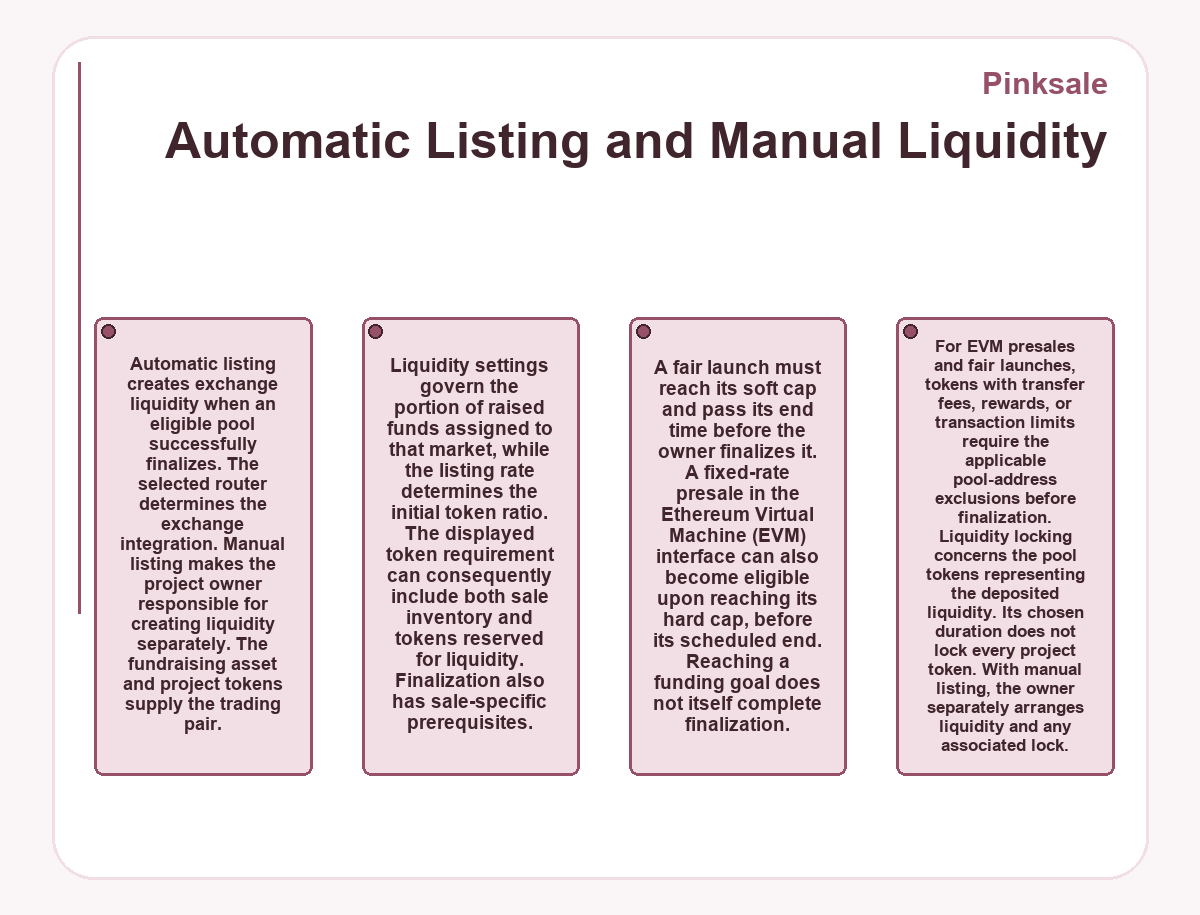
The fundraising asset and project tokens supply the trading pair. Liquidity settings govern the portion of raised funds assigned to that market, while the listing rate determines the initial token ratio. The displayed token requirement can consequently include both sale inventory and tokens reserved for liquidity.
Finalization also has sale-specific prerequisites. A fair launch must reach its soft cap and pass its end time before the owner finalizes it. A fixed-rate presale in the Ethereum Virtual Machine (EVM) interface can also become eligible upon reaching its hard cap, before its scheduled end. Reaching a funding goal does not itself complete finalization. For EVM presales and fair launches, tokens with transfer fees, rewards, or transaction limits require the applicable pool-address exclusions before finalization.
Liquidity locking concerns the pool tokens representing the deposited liquidity. Its chosen duration does not lock every project token. With manual listing, the owner separately arranges liquidity and any associated lock.
PinkLock and the Reach of a Liquidity Lock
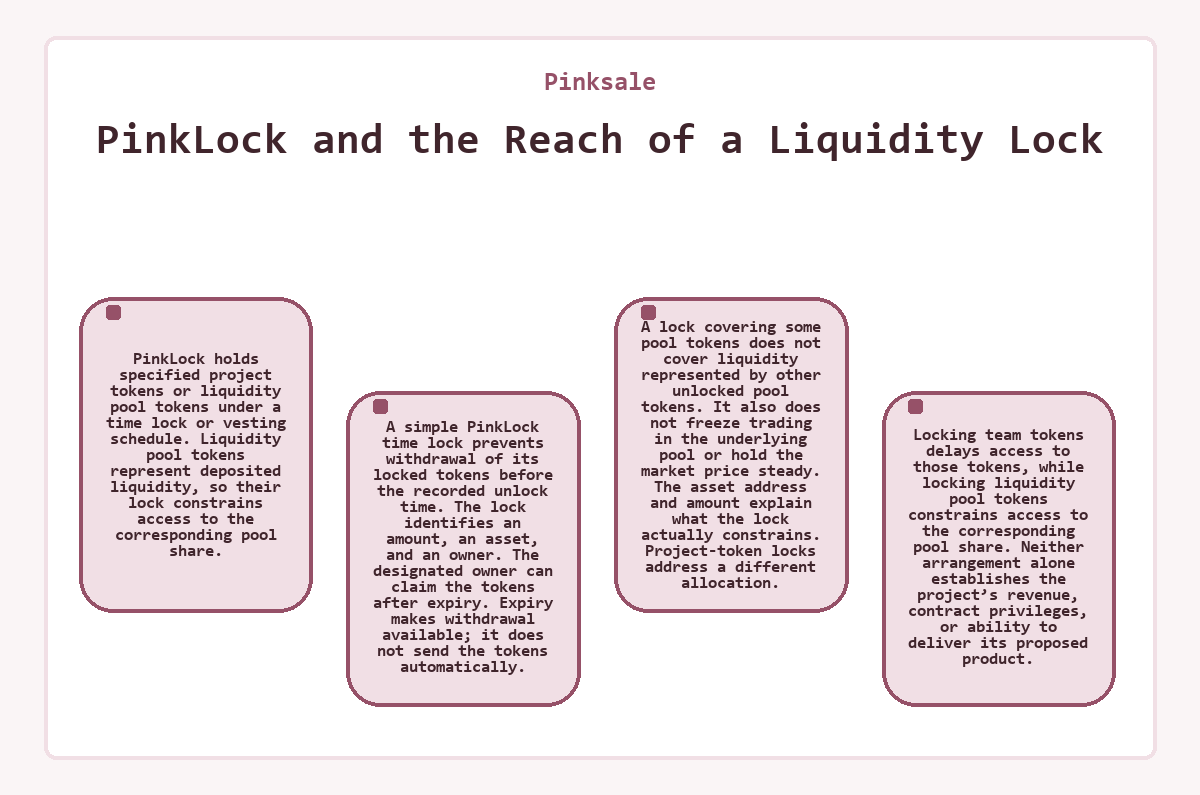
PinkLock holds specified project tokens or liquidity pool tokens under a time lock or vesting schedule. Liquidity pool tokens represent deposited liquidity, so their lock constrains access to the corresponding pool share.
A simple PinkLock time lock prevents withdrawal of its locked tokens before the recorded unlock time. The lock identifies an amount, an asset, and an owner. The designated owner can claim the tokens after expiry. Expiry makes withdrawal available; it does not send the tokens automatically.
A lock covering some pool tokens does not cover liquidity represented by other unlocked pool tokens. It also does not freeze trading in the underlying pool or hold the market price steady. The asset address and amount explain what the lock actually constrains.
Project-token locks address a different allocation. Locking team tokens delays access to those tokens, while locking liquidity pool tokens constrains access to the corresponding pool share. Neither arrangement alone establishes the project’s revenue, contract privileges, or ability to deliver its proposed product.
Vesting Schedules and Claimable Tokens
Vesting divides the locked token amount into releases governed by dates and percentages. Team-vesting settings include an initial release at the token generation event, or TGE, followed by releases after configured cycles. Both the initial-release percentage and each cycle-release percentage apply to the total token amount assigned to that vesting lock.
The starting date and cycle length control when each portion becomes available. A displayed total allocation can therefore exceed the amount currently claimable. Contributor vesting serves another allocation: it controls when purchased sale tokens become available to contributors. A team schedule does not establish a buyer’s claim schedule, and a buyer’s vesting arrangement does not describe liquidity.
Networks and Wallet Context
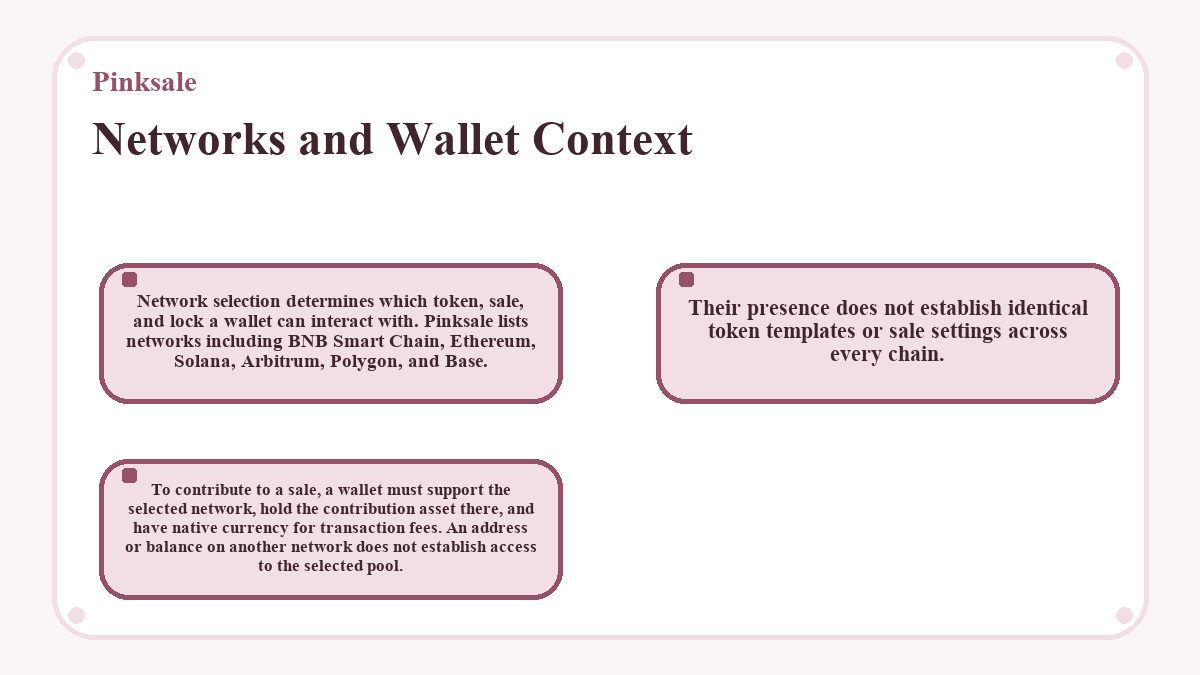
Network selection determines which token, sale, and lock a wallet can interact with. Pinksale lists networks including BNB Smart Chain, Ethereum, Solana, Arbitrum, Polygon, and Base. Their presence does not establish identical token templates or sale settings across every chain. To contribute to a sale, a wallet must support the selected network, hold the contribution asset there, and have native currency for transaction fees. An address or balance on another network does not establish access to the selected pool.
What Do KYC and Audit Badges Establish?
KYC badges concern project-owner identity, while audit badges concern a review of the project’s smart contract. Know Your Customer verification checks identity documents. An audit badge requires a report from a recognized audit partner. These badges describe different checks, and neither determines the project’s future market price. Pinksale can disclose a verified team member’s identity if it finds that person scammed participants.
A contract audit evaluates the code covered by its report. Its findings and unresolved issues define the scope of that review. Identity verification does not establish how a token contract handles transfers or owner permissions. A code review does not establish the identities behind project claims. Locked liquidity adds a separate constraint on withdrawals, without answering those identity or code questions.
Which Costs Belong to a Launch?
Launch costs can include token creation, sale setup, fundraising-based service charges, and blockchain transaction fees. The selected network, tool, and fee option determine the applicable combination.
A percentage service charge needs its stated asset and calculation base; it is not automatically a percentage of the project’s entire token supply. Network fees belong to the transactions a wallet authorizes. They remain relevant when a particular platform service has no separate service charge. Optional services and tools can add their own costs. The token quantity needed for a pool is also distinct from a fee: some tokens supply contributor allocations or initial liquidity instead of paying the platform.
Listing Details and Supporting Tools
Project listings combine token information with a logo, description, website, and social links. Management tools let owners update listing content. These descriptive fields help explain a proposed project, while the associated token contract governs its on-chain behavior. Editing a description does not alter the asset’s code.
The launch calculator provides a spreadsheet for planning token distribution, liquidity requirements, and funding goals. The wider toolset includes airdrops, a multi-sender, and optional anti-bot features. These serve distribution or launch-management tasks alongside fundraising. DexView supplies price charts within the surrounding ecosystem. The PINKSALE token is a separate asset from the project tokens sold through the launchpad.
Participation Rules and Sale Outcomes
Participation follows the selected pool’s contribution currency, any sale window, wallet limits, and access settings. An enabled whitelist restricts contributions to approved addresses. The sale format then governs allocation, and any contributor vesting determines when purchased tokens become claimable.
A failed fair launch that ends below its soft cap allows contributors to claim refunds. A successful sale follows its finalization and token-claim conditions instead. A standard presale can finish successfully below its hard cap, so unused capacity alone does not make contributions refundable.
Pinksale: quick answers
Why Does Approving Tokens Leave My Presale Pool Uncreated?
In an EVM presale, token approval authorizes the launchpad contract to access the required project tokens. The pool-creation transaction performs a separate operation after approval confirms. A successful approval alone therefore does not establish an active sale pool. Pool creation requires its own successful blockchain confirmation and enough native currency for its transaction fee.
Can I Change a Presale Whitelist After Creating the Pool?
EVM presale owners can enable or disable the whitelist and add or remove approved wallet addresses after pool creation. These changes require the owner wallet and blockchain transactions. While the whitelist is enabled, contribution access follows the approved address list. Connecting another wallet does not inherit an address’s whitelist status, so the actual contributing address matters.
Who Can Claim a PinkLock Lock After Ownership Transfers?
The new designated owner controls claims after a successful lock-ownership transfer. The previous owner loses control over that lock, while its tokens remain subject to the original release schedule. Transferring ownership changes the wallet entitled to claim; it does not make the locked tokens immediately available. The new owner can also initiate a subsequent ownership transfer.
What Happens If I Renounce Ownership of a PinkLock Lock?
Renouncing lock ownership transfers control to an inaccessible address and permanently prevents anyone from claiming the remaining locked tokens. Expiry or completion of a vesting schedule does not restore access afterward. This action differs from transferring ownership to another controlled wallet. It affects the specific lock and leaves its remaining tokens inaccessible, including amounts whose release dates have already passed.
Does Missing a Vesting Claim Date Cancel the Released Allocation?
Unclaimed PinkLock vesting releases accumulate for later claiming by the designated owner. Passing a release date makes that scheduled portion available without requiring an immediate claim. When several cycles have completed, a later claim can include their accumulated available amounts. Future portions remain governed by the original schedule, and a claim still requires the appropriate wallet and network transaction fee.
Are Rebase Tokens Compatible With Pinksale Team Vesting?
PinkLock team vesting does not support rebase tokens. Its schedule applies release percentages to the token amount assigned to the lock. A token’s inclusion in another launchpad feature does not establish compatibility with team vesting. Transfer fees, rewards, and transaction limits also need the relevant lock-contract exclusions when applicable; those requirements do not remove the rebase restriction.
Must Sale Participants Complete the project-owner KYC Process?
The project-owner KYC process applies to project owners or core team members, rather than sale participants. Its badge identifies a check on the people behind a listed project. Separate pool access rules, including an enabled whitelist, still determine whether a particular wallet can contribute. A project’s KYC badge does not enroll a participant or grant that wallet contribution access.
Which standard-token Details Remain Editable After Minting?
The standard-token creator fixes the name, symbol, decimals, and total supply when it deploys the token contract. Those core details cannot be edited through that creator afterward. Changing a launchpad description or logo does not change them. This restriction concerns the documented standard-token template; a custom token’s permissions follow its own contract.